
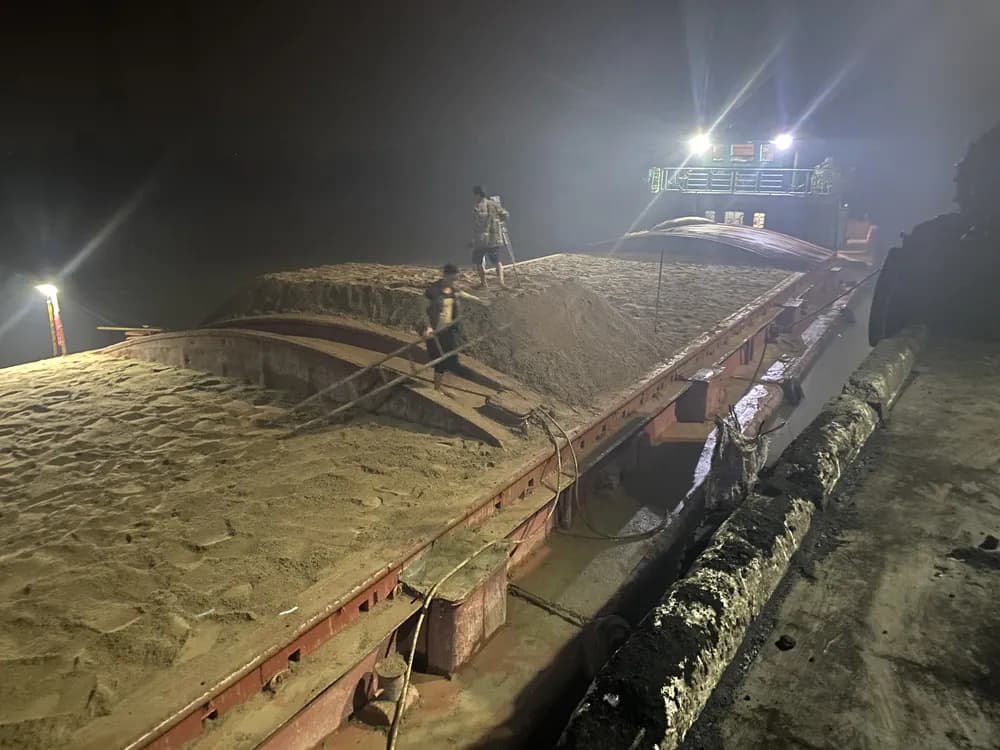
A DIFFERENTIATED CAPABILITY
Consignment-level source traceability system
This is the capability in which we have invested most heavily and our clearest point of differentiation from most fill-sand suppliers in the market.
REGULATORY CONTEXT
Requirements under Article 88
Article 88 of Vietnam's 2024 Law on Geology and Minerals imposes strict requirements on trading riverbed sand and gravel:
- Register wharves and stockpile locations
- Install voyage-monitoring equipment and connect data to provincial regulators
- Contract with duly qualified vehicle or vessel owners
During a regulatory site inspection, the most difficult question is: Which licensed source did this sand at the site come from, on which vehicle or vessel, and on what date?
Most sand supply chains cannot answer this because procurement and sales records lack a verifiable link.
OUR CONTROL METHOD
Assign a unique batch code to every shipment
The batch code is derived from the delivery date and vehicle or vessel identifier and is printed on both sides of the document chain—procurement and sale.
BATCH-CODE EXAMPLE
260731-HP3388
- 260731
- Delivery date — 31 July 2026
- HP3388
- Transport vehicle/vessel identifier
For every delivered consignment, we can trace it back to the specific licensed extraction source and the exact vehicle or vessel used.
DOCUMENTATION
Origin-documentation set accompanying every consignment
| # | Documentation | Customer assurance |
|---|---|---|
| 1 | Copy of the source's mineral-extraction licence | Evidence of lawful material origin |
| 2 | Source warehouse-release note issued by the extraction operator | Links the consignment to its extraction source |
| 3 | VAT invoice | Supports input-tax deduction and cost recognition |
| 4 | Vehicle or vessel registration | Identifies the transport vehicle or vessel |
| 5 | Inland-waterway vessel voyage-monitoring data | Enables reconciliation with regulatory data |
| 6 | Delivery and quantity-acceptance record for each shipment | Confirms the actual delivered quantity |
Back-to-back obligations across the supply chain
Origin-documentation obligations are not merely verbal assurances. We execute contract appendices on a back-to-back basis with upstream suppliers. Any record lacking vehicle or vessel identification is not accepted as valid evidence and creates no payment obligation. Our customer commitment is therefore secured by a matching upstream obligation.
PROCESS
Five steps from supply planning to document handover
- 1
Supply planning
Agree the delivery schedule and quantities against the buyer's construction programme.
- 2
Release at source
Collect the material from the extraction operator and obtain the consignment's origin documents.
- 3
Transport
Transport by registered, voyage-monitored inland-waterway vessel, or by road.
- 4
Acceptance
Measure quantity on the vehicle or vessel, obtain both parties' signatures, and capture authenticated site photographs.
- 5
Document handover
Hand over the complete origin-documentation and payment file for the corresponding consignment.
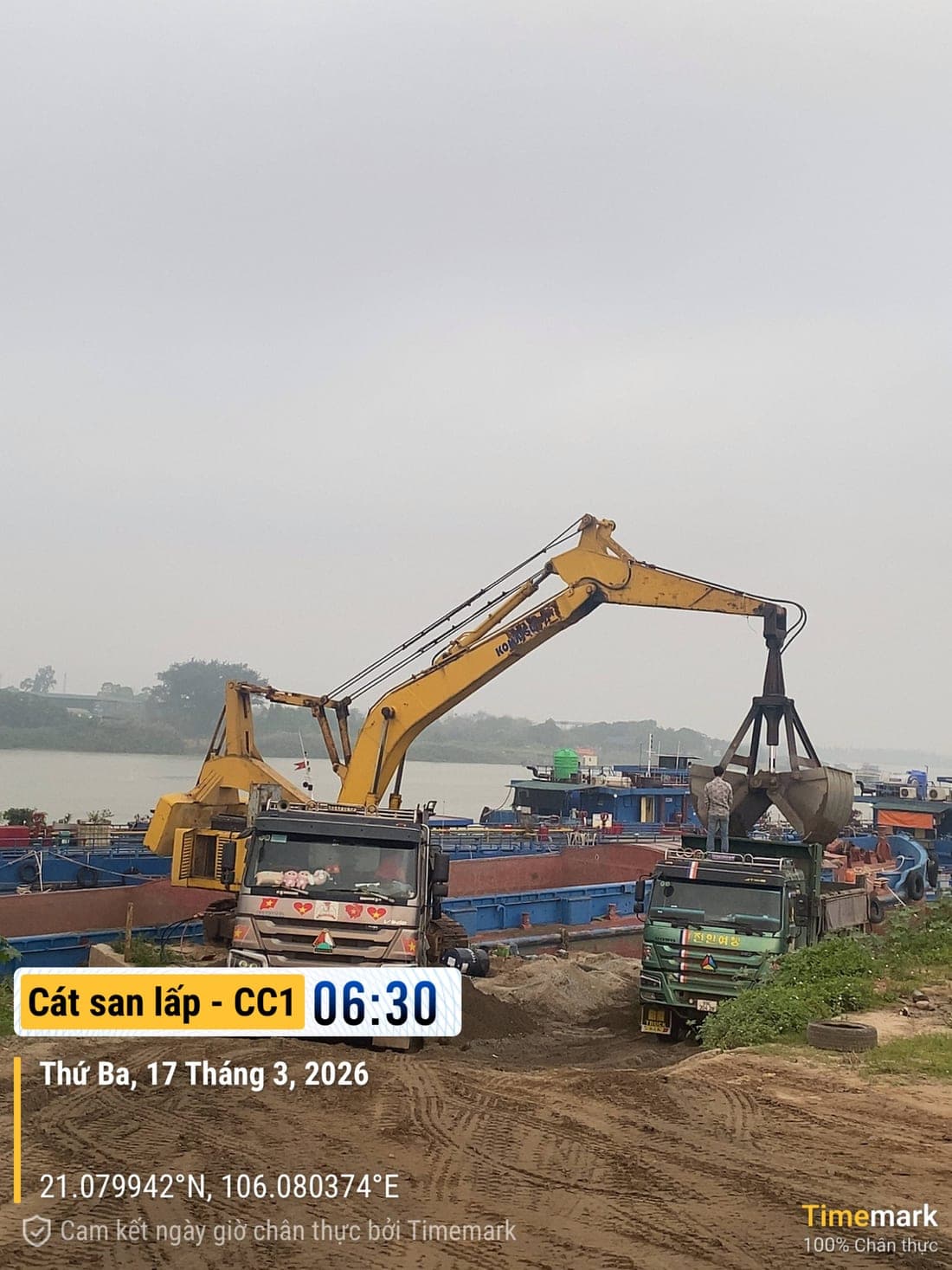
Site photographs authenticated by time and geolocation
Each shipment is photographed using an authentication application that records time, location, and a unique image code. The images are retained with that shipment's acceptance record and supplied to the customer with each payment file.
This is the final evidentiary link between paper records and the physical material at the project site—something that even a complete document set cannot prove without authenticated site images.
MATERIAL SOURCE
Source-material approval file at the extraction site
The sand source offered for supply has been sampled, laboratory-tested, and approved for a major infrastructure package in the Hanoi area, covering site formation and soft-ground treatment works.
Benefit to the project schedule: because the material source already has an approval file, your organisation may avoid repeating source-approval procedures, subject to project requirements—reducing time spent on sampling, testing, and supervisory-consultant submission.
This is a source-material approval file issued for the extraction site, not a certificate in our company's name. It is provided together with the upstream procurement-contract chain for your verification.
Laboratory test results
Testing conducted in June 2026 by an accredited construction-material laboratory holding an LAS-XD code.
- Material
- Black sand — intended use: embankment fill
- AASHTO M 145 classification
- Group A-3
- Liquid limit — plastic limit
- Non-plastic
- Swell
- 0,00%
- Overall assessment
- All tested parameters met the specified requirements
A complete copy of the laboratory test report, including all parameters and measured values, is available directly upon request.
COMMITMENTS
Six commitments to project owners and contractors
01
Legally sourced materials
Materials are sourced from licensed extraction operators. We assume responsibility for the lawful status of the goods under Article 45 of Vietnam's 2005 Commercial Law and for the accompanying origin-documentation set.
02
Verified delivered quantity
Each shipment is measured and accepted in the presence of both parties and documented in a signed record. Independent inspection is accepted if the parties disagree on quantity.
03
Supply schedule
Supply is scheduled against the agreed construction programme. Any change in source availability or weather conditions is communicated promptly so both parties can adjust proactively.
04
Regulatory documentation support
Provide records and supporting documents and assist with substantiation when requested by your organisation or a state authority in relation to supplied materials, including after contract close-out.
05
Transparent payment records
VAT invoices are issued in full and at the required time. All transactions are settled by bank transfer.
06
Confidentiality
Maintain the confidentiality of project information, unit prices, and customer commercial terms in accordance with the contract.